Tuesday, August 18, 2009

Heirloom Tomato Bruschetta


The heirloom tomatoes are at their peak right now. They are plump, juicy and burst with flavor. We are eating all kinds of cherry, early girl, purple Cherokee, yellow boy, red and green zebra, and pineapple varieties. I have developed the best recipe for bruschetta which was served as an appetizer at our Lam Family cooking party on Saturday. Stacy commented that the bruschetta "disappeared like bubbles". Justine, Chrissy and Jennifer ate them almost as fast as they made them. I like the hint of garlic notes in the vinaigrette and in the oil brushed onto the bread. We used early girl, yellow boy, and red zebra tomatoes. The combination of tomatoes made the bruschetta beautiful and delicious.

Bruschetta
1 sweet baguette sliced into ovals
4 medium tomatoes chopped
2 cloves garlic minced
2/3 cup of olive oil
Basil chiffonade as garnish

Method
Heat garlic and oil to a sizzle and remove from heat (infuses the garlic into the oil)
Brush one side of bread slices with oil and toast
Reserve garlic oil to make vinaigrette

To serve, toss tomato chunks in vinaigrette
Top bread slices oil side up with tomato chunks using a slotted spoon
Garnish with basil and serve

Balsamic vinaigrette

Ingredients
3 tablespoons balsamic vinegar
2 tablespoons fresh lemon juice
1 teaspoon Dijon mustard
1 teaspoon kosher or sea salt
1/2 cup garlic infused olive oil (see above)

Method
Mix first four ingredients into a bowl
vigorously whisk oil in a stream to emulsify

Tuesday, August 11, 2009

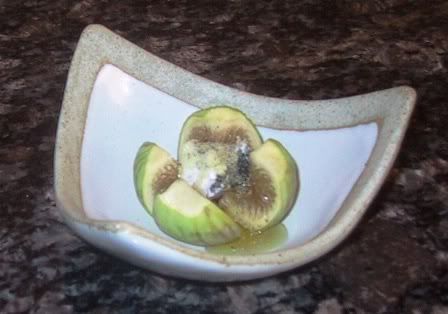
Fresh figs with chevre and peppered honey


Fresh figs are in season now and they are delicious. I came across a wonderful appetizer recipe using fresh figs that I used as an amuse bouche for a multi-course meal on Saturday evening. It is elegant, delicious, easy to make and beautiful to look at.

Fresh figs with chevre and peppered honey

2 oz of floral honey ( I used blackberry)
Several grinds of black pepper from the mill

Mix honey and pepper together in a small bowl.

12 figs
2 oz chevre. (I used the Humbolt Fog which is made by Cypress Grove)

Wash and clip the points off the figs.
Slice the figs into quarters from where the point was to almost the bottom, leaving the bottom attached so that you can open the fig. Did you know that figs are actually flowers that have turned in on themselves? That's why the inside looks like a flower when opened up.

Place each fig on a platter as an appetizer or on individual small plates as an amuse bouche. Put a small piece of the chevre in the center of each fig. Like all cheese courses, let the dish rest for about an hour so that the cheese ripens. Then drizzle the peppered honey on top and serve.
Note: The honey goes on just before service since it will run out of the fig onto the plate if you put it on and then ripen the cheese.

Enjoy!

Friday, July 17, 2009

Veal Stock is Elegance

If you want to run with the big cooks you gotta learn to make veal stock as veal stock is the perfect canvas to illustrate a sauce onto. Veal stock is rich although by itself seems neutral. When it is the base of a sauce, though, it makes the flavors of the sauce pop.

I don't like stocks that are in boxes and cans at the grocery store for many reasons pertaining to healthy eating. I especially don't like them since they seem devoid of what makes stock magical in a sauce: GELATIN! To get the best flavor and texture in my stock, I make from scratch. I make gallons of chicken stock particularly in the summer when chicken appears as our entree frequently. Chicken stock is the most versatile stock for light soups and I love it in risotto and pasta. Veal stock, on the other hand, I make in small quantities since I buy the bones from my butcher specifically for stock making (for chicken stock I always have plenty of carcasses in my freezer because I buy whole chickens and de-bone them myself). The expense and scarcity of veal stock in my freezer means that we only use the stuff for special occasions.

This Saturday I am cooking for three other couples and us as our turn in the HDASA annual rotation. HDASA, "Hammered, Drunk, and Stupid Again", is our wine and food group. The odd name was chosen to make the point that we don't take ourselves too seriously. I think it was captured in a round table brainstorming when we all had drunk quite alot of really good cab which made the name reflect the condition we were in at the time. But I digress. I care a great deal about these folks, so I put my heart and soul into the meal whenever it rotates to our house. As part of the prep, I made a pot of veal stock that I will use in a sauce for the lamb shank with Cabernet sauce entree.

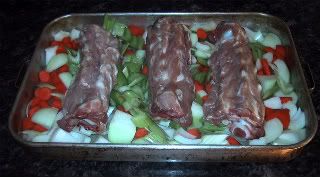
This stock started with three veal necks from the local butcher. Necks and other knuckles make excellent stocks because of all the connective tissue in the joints. The total weight of the three necks was about five pounds which is a good amount for my 8-quart stock pot (I make chicken stock in a 16-quart model).

Veal Stock
5 lbs veal necks or other joints
3 yellow onions cut into chunks
4 medium carrots cut oblique
6 outside celery stalks cut on a bias
2 leeks washed. Pale parts sliced length-wise. Some of the dark green leaves reserved for the bouquet de garni
1 bunch parsley

Bouquet de Garni
A selection of herbs and spices tied into a leek leaf bundle.
For this stock I chose two bay leaves, rainbow peppercorns, fresh rosemary, fresh thyme, fresh oregano, and fresh marjoram.

Method
I like to roast the bones for a richer, more complex stock.
Pre-heat oven to 375 degrees F
Spread vegetables in a roasting pan and set the veal on top of the vegetables.
Roast until the meat is golden (lighter color makes a lighter stock, darker makes a darker stock)

Place roasted meat in stock pot and fill the pot 3/4 with water that covers the meat.
Bring the stock to a slow boil and skim the scummy foam from the top.
Add the roasted vegetables and bouquet. Return to a slow boil, skim, and lower heat to a tremble. A tremble is barely a simmer. You see the occasional bubble at the surface of the stock. This allows the stock to develop without turning the vegetables to mush.
After three hours add the parsley and cook one hour more. Add water if it gets too low. As the bones break down they make room for reduction. When I finish I have about 1/2 to 2/3 of a pot loaded before straining.

It is important to cool a stock quickly to avoid souring the stock. I fill my sink 1/2 with cold water and place the stock pot into the water. I let the water continue to fill the sink until the pot is about to float or the sink overflow, whichever comes first. Stir the stock and the sink water simultaneously to speed heat transfer.

Once cool enough to hold your finger in the stock, start the straining process. I start by using a slotted spoon to scoop out bones and vegetables from the stock pot to a coarse strainer set over a mixing bowl or other pot. Press hard on solids. When the solids are removed from the stock I strain the stock through a fine-mesh china cap into the bowl, followed by a second strain back to the stock pot. I then put the strained stock into containers that will be set in the refrigerator overnight to "freeze" the fat. It is important to de-fat any stock and this is the most efficient way. The next day you skim the frozen fat off the stock. I use the fat for frying eggs.
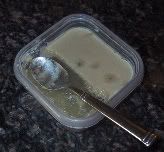
If you did a good job on the stock, the cold stock will be set like Jello, which is a protein-rich, low-fat goldmine. If you want demi-glace reduce the stock by 3/4.

Now, to make the peach ice cream dessert!

Tuesday, July 14, 2009

Urban Foraging


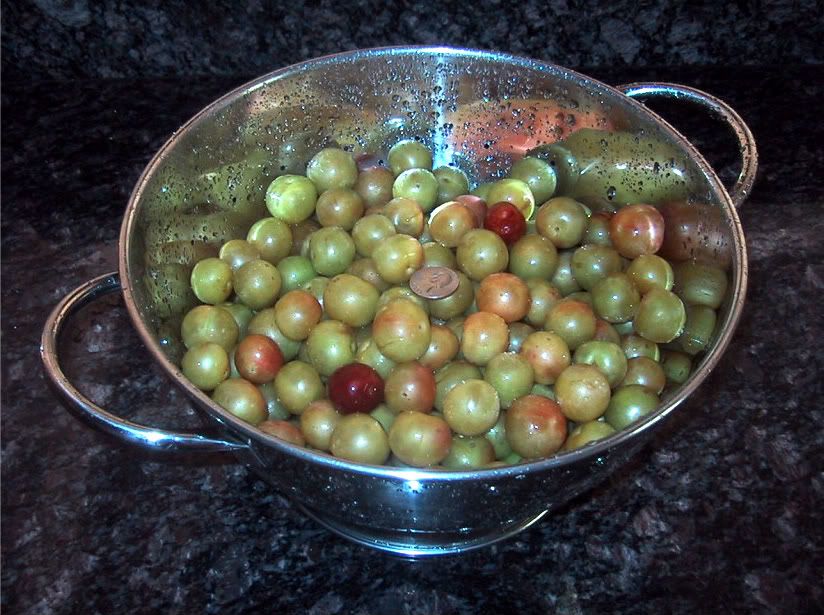
As Stacy and I walk through our neighborhood every morning with our dogs, we see the changing seasons which includes the ripening and all too often wasting of fruits from ornamental fruit trees. Stone fruit trees are beautiful in the spring when they show their tiny, blushing blooms. As spring turns to summer, the fruits grow into flame-colored spheres hanging beneath the green leaves. One particular house along our walk has two plum trees that grow between their back fence and a street. They don't prune or water the trees, yet the trees faithfully produce an abundance of small, intensely sweet plums year in and year out. One is a green plum and the other a small red. Both are of the Hardy Plum variety which are more well suited to Northern climes, which also do very well with little or no water, and thus appear as drought tolerant trees in home landscapes.

In mid summer as the fruit ripens and falls to the ground, it saddens me that the homeowners don't show more respect to their faithful trees by eating and preserving the fruit. Instead it falls to the ground to turn into mush which feeds the rodents, opossums, and raccoons that sulk around our neighborhood at night. Or it rots, which attracts green-bottle flies, biting flies, ants, and other annoying insects.


This year, I decided to harvest as much of the fruit as I could reach when it ripened. In about fifteen minutes I had acquired one and one-half gallons of the tasty fruits and only a few puncture wounds and scrapes from the nasty thorns hiding on the thicker branches. The project made me appreciate why our ancestors devised ways to preserve fruits as almost the entire crop ripened within one week. We are hosting a meetup August 2 when we will be preserving fruits using the hot-water bath processing method, in which we will process jars of jam. These plums will make a star appearance at the event and later this year when I am enjoying some on a piece of toast I will remember the warm July day that I picked the fruits.

Monday, July 13, 2009

The epitome of summer: Chilled Watermelon Mint Soup

This refreshing soup is the epitome of a warm summer day. I first made this dish as part of a multi-course meal paired with champagne and was hooked. This is not an easy dish to make as the watermelon must be pureed and sieved. I recently purchased a power juicer that makes the job much, much easier. If you don't have a juicer, I have made it many times using a sieve, so I invite you to take the time as your guests will love it.

Here's the recipe


Another challenge with this dish is to balance the sweet, salt and chile flavors. I have over spiced, over salted and over sweetened this soup to learn how to dial in the flavors. The best technique is to pour a small amount of the soup into a separate bowl and experiment with the flavors. When you get the small portion to taste perfectly, then scale the measure to the entire pot. I also recommend that you chill the soup overnight to let the flavors blend and mellow the chile a bit.


I also made watermelon sorbet from the other half of the melon since a half a melon easily makes enough soup for eight servings.

Watermelon on Foodista

Serrano Pepper on Foodista

Monday, July 6, 2009

Avocado Corn Soup


When the weather warms up, I like to prepare dishes that are served cold for two reasons: One the dishes are refreshing; and two, I don't have to heat the kitchen to serve the dishes, although they often do require cooking which may be done ahead. Also, I like to serve dishes in the summer that pair well with crisp wines, which introduces a broader palette of spice flavors and citrus to my cooking. One of my favorite is this avocado corn soup that is served chilled. The flavors in this dish are bold yet perfectly balanced. It may be made a day ahead except for the cilantro infused olive oil that is made no more than three hours ahead. It's a nice vegetarian dish which can be made vegan if the sour cream is omitted.

It's fun to make too. The stock of the soup is made by boiling corn cobs, corn and onions together with a bit of salt as if the cobs are the bones in the stock. The soup is brought together in a blender and then chilled for serving. Avocado balls are added to the soup as the meat of the soup to give texture to the dish. It is delicious and beautiful to look at too.

Avocado Corn Soup

6 servings as a soup course

Soup Ingredients
1 fresh ear of corn shucked
1 garlic clove peeled and smashed
4 cups water
1 1/2 teaspoons salt
1 1/4 cup minced sweet onion (vidalias work great)
1 fresh Serrano chile stem and seeds removed then the chile is minced (add the seeds back if you want more heat)
2 firm-ripe avocados
Juice of one lime
Sour cream (about 1/4 cup)

Cilantro infused olive oil ingredients
1 bunch cilantro torn from stems
1/4 cup extra-virgin olive oil
1/2 teaspoon salt

To make the soup, grill the corn until the kernels are lightly caramelized. Cut corn from cobs, and cut cobs into thirds. In a saute pan add water, corn cob pieces, corn, 1/2 cup onion, garlic and salt and bring to a boil. Reduce by half, remove and discard cobs, and transfer the rest to a blender and add in the chile. Blend until smooth. Add the flesh of 1-1/2 avocados to blender and blend until smooth again. Adjust seasonings and cool.

Prepare cilantro oil: Place all ingredients in a blender and blend until the cilantro is pulverized. Strain through a fine sieve into a bowl without pressing on solids. The oil should be bright green.

To serve, place soup in a bowl and cut balls of avocado with a melon baller and add to soup as the meat. Drizzle with sour cream and cilantro oil and enjoy.

Tuesday, June 23, 2009

Menu Planning

Stacy and I support the Taste of Howell Mountain auction every year which is a wine tasting and auction that benefits the Howell Mountain Elementary School. The only public school on the mountain. Our good friends Jacalyn and Allen Spence have been building a boutique winery around their home off White Cottage Road in Angwin up there. She is the President of the Howell Mountain Vintner's and Grower's Association that produces the auction each year. This year Spence Family Vineyards has teamed up with Summit Lake Vineyards to host a dinner and movie party for fifty at Summit Lake on September 12 as one of the auction items. Since I have been unemployed for several months now, Stacy and I decided we wouldn't bid at the auction, so I volunteered to cook the meal for the September 12 party. The party is oversubscribed for 52 diners at $100 per person, which is a huge success. Of course when you add in the staff to support the event, I have to plan and execute a meal for at least 60 people at a location that has limited kitchen facilities.

The first step to planning a dinner party is to align all stakeholders on the vision for what a successful event is. The criteria we agreed on are:
Elegant outdoor dining experience for the guests that will be served in the vineyard
Pair the entree with Howell Mountain Cab

My constraints include :
Cook off site and transport to the dinner
Make the meal profitable for the charity
Use volunteers as kitchen and service staff
Limited kitchen facility at the dining location

Once we agreed on the vision for the meal and understand the constraints, then comes the menu planning. With that many people there will likely be some folks that subscribe to a vegetarian diet, so the menu will be all vegetarian except the entree which will have both a meat and vegetarian option. Elegance means multiple courses served on individual plates delivered to the diners at the table versus a buffet style meal. I decided to execute a five course dinner with four courses served cold and the entree served hot. Here's the menu:
Appetizers
Heirloom Tomato Bruschetta
Hardy Lodge Cheese Straws
Soup
Salad
Heirloom Tomato Salad Napoleon with Bufula Mozzarella and Basil
Entree
Atop Tuscan Runner Bean Puree
or
Tuscan White Beans in Howell Mountain Cabernet Sauce with Germolata (vegetarian)
Gorgonzola Polenta
Dessert
Flour-less Chocolate Cake with Homemade Raspberry Ice Cream
Sounds good, huh? Note that only one course is served hot which is braised. This entire meal can be made days ahead with minimal cooking for service. Also, note how the appetizer links to the salad course. The salad is made by slicing tomatoes of different colors; staking four slices per serving then cutting the stacks into perfect squares. This creates a beautiful presentation while removing the skins from the salad. The trim is then chopped into small chunks for the bruschetta so that nothing is wasted. The dressing for the salad is the same as the bruschetta. To make the meal more interesting, the bruschetta will be served on a baguette slice that is brushed with garlic-infused olive oil. That way the two dishes become distinctly different despite being made from common ingredients. Also, since the soup course separates the appetizers from the salad course, the diners will feel that the meal is diverse and varied. And also beautiful and delicious. Also, there are two appetizers that are completely different to add depth and complexity to the tastes the diners will experience. All while making it easier for the cook to execute the meal. The cheese straws will be baked that morning and served room temperature.
The soup is served cold, so it is easily transported. However, the dish does present challenges: While the stock of the soup is a combination of white onions and corn husks, which can be made days ahead and chilled, avocado easily spoils, which is the meat in the soup. The soup will be made one day ahead and transported in coolers then the avocado balls added on-site so that the avocados are transported in their shells and processed right before serving to ensure freshness. Another challenge in the soup is the cilantro oil since the herb carries bacteria that are harmless until they see an environment with no oxygen, like being suspended in olive oil, so the cilantro oil must be made about an hour before service. The ingredients will be blended on-site to execute that ingredient and avoid making any diners ill. The tomatoes are also a challenge to keep them fresh, so they will be cut on-site and the slices refrigerated until time to serve the salad. The entree will be made days ahead, which makes a better product since the flavors marry in the dish. It will have to be re-heated on-site, so we need oven space for 60 lamb shanks. That will be a challenge. The ice cream will be made ahead and brought frozen. Cakes can be made ahead too, so that won't be hard.
I will describe the process for planning the execution of the meal in an upcoming blog. Stay tuned!